Levenhuk Wise 8×42 monocular

Had a chance to test the Levenhuk Wise 8×42 monocular, and was very pleased with the results. So firstly lets talk about the price. £35 at the time of this review. So for £35, surely you are going to get standard coated optics and BK7 prisms ?. Not in this case. What you get is multi-coated optics and BaK-4 prisms.

So what about build quality ?. Very solid with a rubber covering. Twist eye cup with a very generous 18mm eye relief. However these are not nitrogen gas filled. But hey, FMC, LER, BaK-4 prisms, 42mm objective lens. For £35 what,s not to like.

On to the all important handling and view through the eye piece. What you get is very sharp colours, nice contrast and a bright image, that is helped by the 5mm exit pupil. Yes you get a little red colour fringing around bright objects with dark back grounds (swans on a lake in this case) and a little fall off in sharpness on the edges. But that is also what you get on much more expensive monoculars. The top focus wheel is a little smaller and stiffer than some, but again lets go back to the £35 price tag.

You get as standard a wrist strap, lens covers at both sides (not all monoculars do), small microfibre cleaning cloth and a very nice soft pouch.

Overall. Optics 7/10, Handling 7/10. Value for money 10/10
Posted in Monocular Reviews | Tagged , | Comments Off on Levenhuk Wise 8×42 monocular

Hawke Sapphire 8×25 ED binoculars review

The Hawke Sapphire ED 8×25 binoculars offer big performance results from a compact set. Features include ED glass with Dielectric coated BaK-4 prisms and water repellent glass.

It is difficult to believe how bright the image is from the small 25mm objective lenses. Colours and contrast are superb in all lighting conditions. Minimal chromatic aberration gives excellent sharpness with virtually no colour fringing.

Although compact and lightweight, they are extremely solid with excellent handling. Take a look at the video below for a closer look.

Posted in Hawke Binocular Reviews | Tagged , | Comments Off on Hawke Sapphire 8×25 ED binoculars review

How to connect a DSLR t-ring and adapter to a Celestron Regal M2 spotting scope

To connect a t-ring to a Celestron Regal M2 zoom eyepiece, you unscrew the twist eye cup anti-clockwise until it comes off. The attach the adaptor ring to the thread, followed by the t-ring for your camera. Note the t-ring is available separate, and the adaptor ring is supplied when you buy the spotting scope (not included with the eyepiece when bought on its own)

You can then enter the wonderful world of digiscoping. Note that with some cameras you will only be able to use manual exposure. Use live screen for more accurate focus. See video below for a hands on demonstration.

Posted in User Guides and Tutorials | Tagged , | Comments Off on How to connect a DSLR t-ring and adapter to a Celestron Regal M2 spotting scope

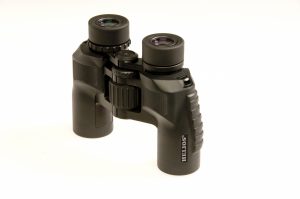
Helios Aquila MS 6.5×32 binoculars review 30133

After looking through 100s of binoculars over the years it takes something special to give me the wow ! factor. The Helios Aquila 6.5×32 are now in this group of binoculars that stand out against most others in the same price range.

As always my reviews will be my own opinions and no one else.

Starting with the outer box, we see a many pink appearance with images of the binoculars and a large bird of prey. You also see the full specs , which are impressive for the price.

So opening the box we find a very standard nylon soft case, nylon strap and small cleaning cloth. OK I have seen better cases and straps, but on much more expensive binoculars..Once however you hold the binoculars, everything changes. They are extremely well built and solid, yet only weigh 500g.

The eye pieces have a one piece flexible guard, and drop down stay on, on the objectives. Unlike some similar 7×30 binoculars, they twist eye cups feel very nice , with small clicks as you unwind them out. Some others feel very flimsy. Not so hear.

So with the eye cups out, lets have a look. This is where the Wow factor kicks in. For such a small 30mm set of binoculars the view is outstanding with a bright and very wide field of view with high contrast and vivid colours. If you like flat field binoculars such as 7×50 and 8×56 you will love these. Internal baffling is excellent with virtually no internal refletion even with the eye cups down.

Do not be put off by the 6.5x magnification. This is more than adequate for mid distance viewing. The wide 4.9mm exit pupil is great for low light observing. I have not tried yet , but bet they will be great for wide field astronomy.

Yes there is some CA, but well within tolerances. One downside is the close focus of around 3.5m (quoted). But for a porro prism design this is one of the better.

Handling is very easy with a grippy rubber covering and large focus wheel. The dioptre is easy to adjust even with the eye cups twisted down.

Summing up, these are truly outstanding binoculars for the price. Stunning optics, build quality and handling the plus points. Only downside is probably the unpadded strap. But this can quickly be remedied if you ask the dealer nicely for an upgrade.

Highly recommend as comprise between 8×42 binoculars and compact 25mm versions

Click Here to buy from Northern Optics and see full specs

Posted in Helios Binocular Reviews | Tagged | Comments Off on Helios Aquila MS 6.5×32 binoculars review 30133

Are all binoculars the same . Myth busted

Sounds like a meaningless question as all binoculars come in different shapes and sizes. But however many look pretty much the same design (some 15×70 for example) . Reading on some forums there are a few people will say they are all the same with regards prisms, lens coatings etc. This is incorrect advice.

But recently I noticed one forum user say that just because some binoculars look the same, they may have different coatings. Finally ! someone who agrees with me.

I hope the video below showing two binoculars that look the same on the outside, are in fact quite different in terms of optical lens coatings. I hope my practical demonstration helps clear up any myth

Posted in User Guides and Tutorials | Tagged , | Comments Off on Are all binoculars the same . Myth busted

Nitrogen waterproof binoculars explained

The video below will give you a clear tutorial on the benefits of nitrogen gas filled binoculars against non fog proof versions. Nitrogen waterproof binoculars are a must have if you go out in all conditions and temperatures

Posted in User Guides and Tutorials | Tagged , | Comments Off on Nitrogen waterproof binoculars explained

Helios Mistral WP6 10×32 binoculars review

With a very solid build and excellent optics, the Helios Mistral WP6 10×32 binoculars off a great choice at around £100. Handling is easy and user friendly

Posted in Helios Binocular Reviews | Tagged , , | Comments Off on Helios Mistral WP6 10×32 binoculars review

Are binoculars with red lenses any good

Binoculars with Red or Ruby lenses look space age and give the impression of reflection free images. In my opinion this is not true. Not everyone will agree with me, but the video below gives my practical look on things

Posted in User Guides and Tutorials | Tagged | Comments Off on Are binoculars with red lenses any good

Celestron Ultima LX 17mm 1.25″ / 2″ eyepiece

The Celestron Ultima LX 17mm is a sensible focal length for general use. Although it does have 1.25″ fitting, we recommend using on a 2″ focuser for a more secure fit.

Posted in Eyepieces | Tagged , | Comments Off on Celestron Ultima LX 17mm 1.25″ / 2″ eyepiece

Lyra constellation wide field using Ostara Moon & Skyglow filter

I took this image of Lyra wide field using a Canon EOS 1100D + a vintage Vivitar 50mm f1.8 lens. By chance the Ostara 2″ Moon / Skyglow filter rests on the 49mm thread lens, but does not screw in. Providing the camera is pointing up it should not fall off. But you could tape into place if you wish.

So as always I use magnified live view for accurate focus. Thinking f1.8 would have poor edge of field coma, I stopped down to f2.8. Coma was still bad, so I set it at f4 which cured the problem.

After some trials at different exposures on an tripod with no tracking, I found that 13 seconds was the most I could go without too much trailing. ISO was 6400. Despite the skyglow filter removing most of the orange skyglow, there was still much processing to be done.

Software used was Canon digital photo professional 4. With this the image was sharpened and chromatic aberration and luminance noise reduced. Used the curves to darken the background sky and enhance the stars. As a final touch I reduced magenta to remove the last of the skyglow

Posted in Images | Tagged , , | Comments Off on Lyra constellation wide field using Ostara Moon & Skyglow filter